
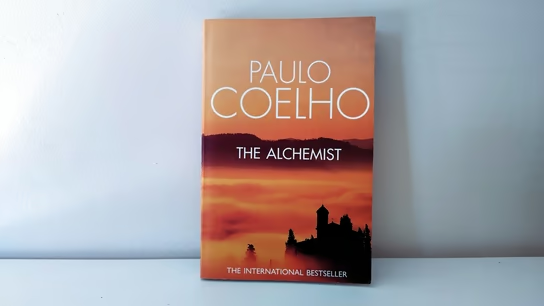
From the back cover:
This is the story of Santiago, an Andalusian shepherd boy who dreams of travelling the world in search of a treasure as extravagant as any ever found. From his home in Spain he journeys to the exotic markets of Tangiers and then into the Egyptian desert, where a fateful encounter with the alchemist awaits him.
The Alchemist is a work of art, plain and simple. After reading it, I remarked that I have never read a book quite like it.
With a deceptively simple and straightforward narrative style, the substance of the story is almost dense and tightly-packed, an utterly wicked and masterful contradiction. Despite this, it left me with plenty of room to fill in the blank spaces in relation to my own existence and life’s journey, much like the protagonist, Santiago. I’m not sure how this reads in the native Portuguese, but the translator Alan R. Clarke has likely done an excellent job in this English version.
A story about self-discovery, it is packed with the usual cliches: the greatest treasures often lie within ourselves, and that the whole universe conspires to help those who pursue their dreams and true calling. So, follow your dreams passionately, despite all the obstacles — there will be obstacles — and above all, keep the faith and never give up.
One could argue that it is self-help, transformative pulp dressed up as a story. Yes, precisely; I think that is the whole point! It is exactly that, a wolf in sheep’s clothing, so to speak. And therein lies the genius of this novel. Paulo Coelho has managed to clothe the wolf, and cleverly disguise it in this inspirational masterpiece.
It subtly encourages the reader to self-examine, always pushing the point which I can only compare to the famous line from The Terminator: “There is no fate but what we make for ourselves.”
One of my favourite passages is when the boy meets Melchizedek:
“Hmm…” said the old man, looking at all sides of the book, as if it were some strange object. “This is an important book, but it’s really irritating.”
The boy was shocked. The old man knew how to read, and had already read the book. And if the book was irritating, as the old man had said, the boy still had time to change it for another.
“It’s a book that says the same thing almost all the other books in the world say,” continued the old man. “It describes people’s inability to choose their own destinies. And it ends up saying that everyone believes the world’s greatest lie.”
“What’s the world’s greatest lie?” the boy asked, completely surprised.
“It’s this: that at a certain point in our lives, we lose control of what’s happening to us, and our lives become controlled by fate. That’s the world’s greatest lie.”
Paulo Coelho has penned a modern classic and fully deserves a second read from me in the future. I have not been able to say that about any book in a very long time. My only regret is not having read this sooner.